

Students at Wirral Grammar School for Boys have been getting creative with robotics and re-engineering rehabilitation along the way!
New to the school, Mrs Biggins wanted to spark interest in engineering and computing, so she introduced a group of Year 8 and 9 students to the Engineering Educates Robotics Challenge: Re-Engineering Rehab. The challenge asks students to design a robotic solution to assist someone undergoing physiotherapy, encouraging recovery and improving fine motor skills.
Easy to use
Working in teams, the boys threw themselves into the task, brainstorming ideas, sketching concepts, coding in Scratch, and even using Blender to model their prototypes in 3D. As they tackled their designs, they weren’t just learning about robotics and programming. They were also developing those all-important transferable skills: critical thinking, collaboration, creativity, and communication.
“It has been a fantastic way to bring together the students’ unique ideas,” said Mrs Biggins. “I’ve been really impressed with their enthusiasm and independent learning. They took on big responsibilities, worked brilliantly in their teams, and created some very detailed prototypes.”

Mrs Biggins found the Engineering Educates resources easy to use and engaging for students at different levels:
“The challenge was really easy to use — just click and go! The instructions were clear, and the variety of resources kept everyone engaged. The sessions were broken into manageable chunks, and the printable resources had a great balance of text and visuals. There were plenty of opportunities for collaboration and discussion, and I’m already looking forward to using more of these challenges in future.”
Inspired by the students’ enthusiasm, Mrs Biggins now plans to relaunch the school’s robotics club and embed more physical computing across the KS3 curriculum:
“Seeing how engaged the boys have been has made me want to bring robotics back. The project’s opened their eyes to how physical computing is used within our real life society — from healthcare to accessibility.”
Innovation in Action
Three teams developed some truly impressive concepts:
The Digital Guitar
One team created a digital guitar to support people recovering from hand injuries. Instead of strings, users press light-up keys, improving dexterity while making music. Sensors collect movement data, allowing physiotherapists to design personalised exercise plans. The team even added Braille markings to make it accessible to blind users.
Their Scratch program demonstrated how the design could boost both physical recovery and mental wellbeing:
“Making music releases feel-good hormones like dopamine and serotonin — it helps people feel accomplished and happy,” the team explained.


The Spinal Rehabilitator 5000
Another group designed a robotic spinal device to support people with spinal injuries. Their concept uses mild electrical stimulation to help retrain the connection between the spine and brain, encouraging improved mobility and independence.


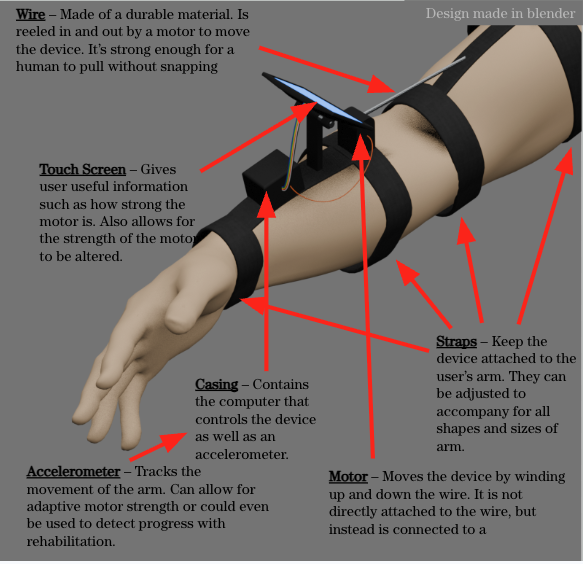
The Arm
A third team focused on upper-body rehabilitation, developing The Arm, a wearable device that moves in response to the user’s exercises. It adapts as muscles strengthen, with an accelerometer detecting progress and automatically adjusting resistance. The students even modelled the design in Blender, demonstrating how it could one day evolve to support other muscle groups or full-body therapy.
Looking Ahead
Mrs Biggins says this project has opened the door to more cross-curricular learning and a deeper understanding of how technology can help people:
“The boys have been so passionate about this project. It’s helped them become more analytical and algorithmic thinkers. I’ve really enjoyed seeing their ideas come to life and am excited to keep building on this work.”
At Engineering Educates, we love seeing how schools like Wirral Grammar are helping students connect creativity, technology, and real-world problem-solving. These young engineers are proof that innovation starts with empathy, and a great idea!